Microneedling in Georgetown.
The treatment for texture you cannot fix with skincare — acne scarring, enlarged pores, crepey skin and fine lines. It works by making your own skin rebuild its collagen, which means the results take months to arrive and then last. It also means two days of looking sunburnt. Both of those are worth knowing before you book.
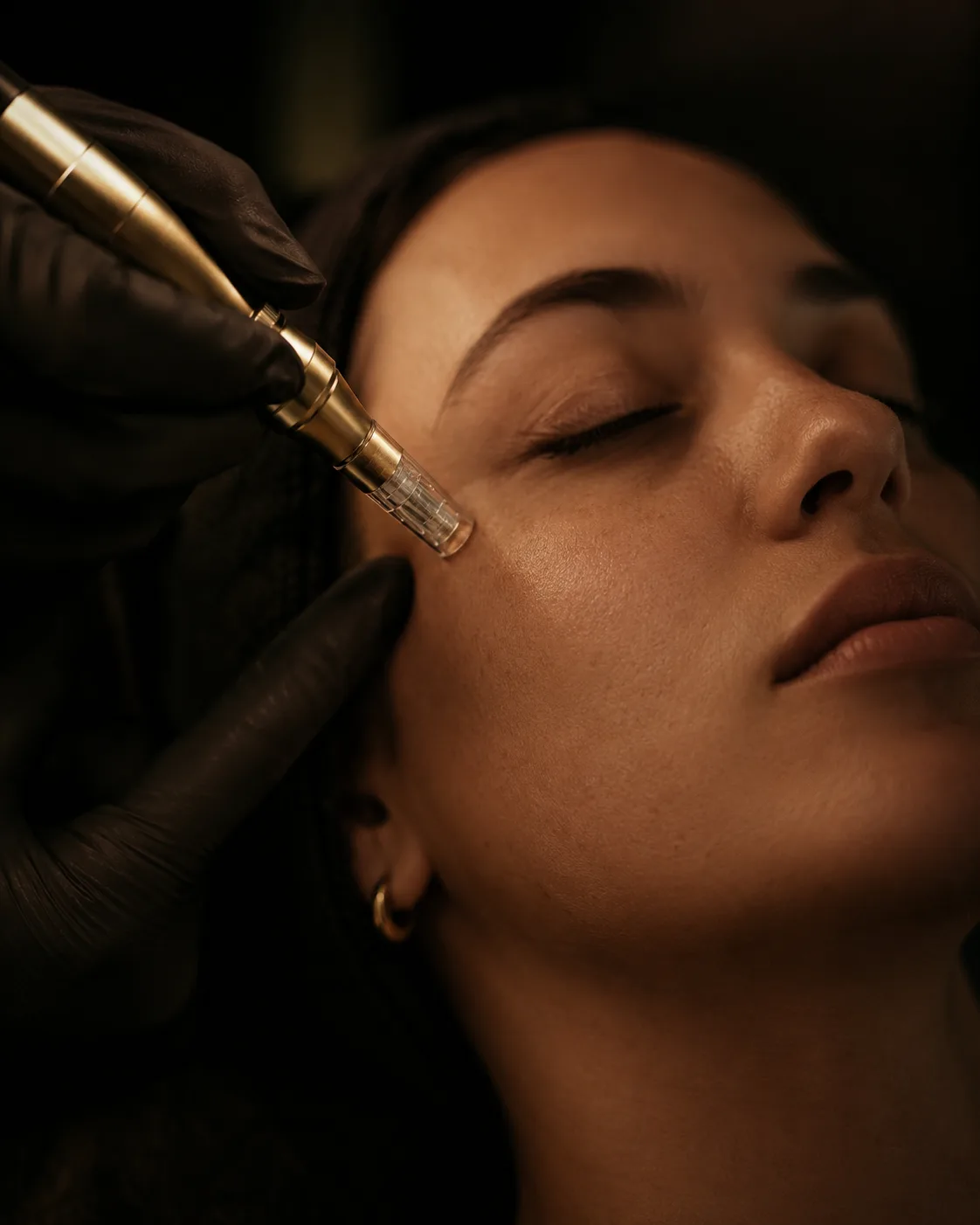
The needles are not the treatment. Your healing is.
A pen fitted with very fine sterile needles passes over the skin, creating thousands of micro-channels at a controlled depth. Each channel is a deliberate, microscopic injury — small enough to close within hours, significant enough that your body responds to it.
That response is the entire point. Injury triggers a repair cascade that produces new collagen and elastin in the layer beneath the surface. Over the following weeks that new structure fills out depressed scarring, tightens the walls of enlarged pores and thickens skin that has become thin and crepey. You are not sanding the surface down; you are rebuilding what sits under it.
This is also why the timeline is slow and why the gap between sessions is not negotiable. Collagen remodelling runs for four to six weeks after each treatment. Booking closer together interrupts a process that is still working.
Strong for structure. Weak for pigment.
What happens, and when.
Managing this expectation is most of the difference between a client who is delighted and a client who thinks it did not work.
Two weeks apart, on the same area.
Microneedling leaves micro-channels open in the skin for several hours and leaves the surface sensitised for a couple of days. Laser hair removal delivers heat into that same skin. Doing both to one area in a short window adds real risk of irritation and pigment change, and adds nothing to your results.
The rule is simple. On the same area, leave two weeks between microneedling and laser in either direction. On different areas — facial microneedling and leg laser, for instance — the same day is completely fine, and if you are driving in from out of town it is the sensible way to book.
A HydraFacial a week or two before a microneedling session is genuinely useful: clear, well-hydrated skin with no congestion responds better. A spray tan is the one to keep well clear of — it should never go on skin that has been needled within the week.
“She takes time to explain the procedure and after-care properly. The space is clean, hygienic and well managed.”
About microneedling.
What is microneedling actually doing to my skin? +
A pen with very fine sterile needles creates thousands of controlled micro-channels in the skin. Each one is a tiny, deliberate injury that your body repairs by producing new collagen and elastin. That is why it is properly called collagen induction therapy — the needles are not the treatment, your healing response is. The result builds over months rather than appearing overnight.
Does it hurt? +
A topical numbing cream is applied for twenty to thirty minutes before treatment, which changes the experience completely. Most clients describe a vibrating, slightly scratchy sensation rather than pain. Bonier areas like the forehead and along the jaw feel sharper than the cheeks.
What is the downtime honestly like? +
Expect to look like you have moderate sunburn for twenty-four to forty-eight hours — flushed, warm and tight. Day two or three often brings slight flaking as the surface renews. It is not a treatment to book the day before an event; book it a week to ten days before, or simply on a Friday.
How many sessions will I need? +
Three to six spaced four to six weeks apart for most concerns, then maintenance every six to twelve months. The gap matters: collagen remodelling continues for weeks after each session, and treating again too soon interrupts the process rather than accelerating it.
When will I see results? +
Immediate plumpness from the inflammation settles within a week, and that is not the real result. Genuine collagen change appears from around four to six weeks and continues improving for up to six months after your final session. Anyone promising a transformation the following week is describing swelling.
Will it help acne scarring? +
This is one of its strongest uses. Rolling and boxcar scars respond well over a course, because you are rebuilding the collagen structure underneath rather than resurfacing the top. Ice-pick scars are narrower and deeper and respond less. Active acne must be settled first — treating over inflamed breakouts risks spreading bacteria.
Can I have microneedling and laser hair removal together? +
Not on the same area on the same day. Microneedling leaves open micro-channels and laser delivers heat — combining them on the same skin is unnecessary risk. Leave two weeks between microneedling and laser on the same area. Different areas on the same day, such as facial microneedling and leg laser, is fine.
Who should not have microneedling? +
Anyone pregnant, on isotretinoin within the last six months, with active cold sores or infection in the area, a history of keloid scarring, or an uncontrolled skin condition in the treatment zone. This comes up at consultation and occasionally the answer is to wait or not proceed.
Is it safe on darker skin? +
Yes, and it is often the preferred option. Because microneedling works mechanically rather than with heat or light, it does not target pigment, so the risk of post-inflammatory hyperpigmentation is lower than with many resurfacing lasers. Aftercare and strict sun protection still matter.
Find out if it is the right treatment.
Microneedling is excellent for some concerns and the wrong choice for others. The consultation is free and Sukh will tell you which category you are in.